Work
Four project examples, four different reasons to reach for AI — or not to.
Want to see everything in one place?
The full reel — every project, one showcase.
Password protected: use DLCMC2026 to unlock.
Loopwell
The client had a big vision for their central character — a full story arc across multiple locations. What they had was a budget that, spent on traditional production, would have bought about 15 seconds in a single location. The gap between the vision and the budget was the whole problem.
Rather than shrink the story to fit the money, I rebuilt the production around AI — serving as AI director of photography, editor, colorist, and sound designer across the full 90 seconds. Every location, every beat of the character's arc that the traditional budget couldn't touch, made it into the final piece.
Skater Zombies
Independent film financing has a chicken-and-egg problem: investors want to see the film before they fund it, but you can't shoot the film without funding. Traditionally, filmmakers pitch around this gap with a deck, some comps, maybe mockup stills — asking investors to imagine the movie.
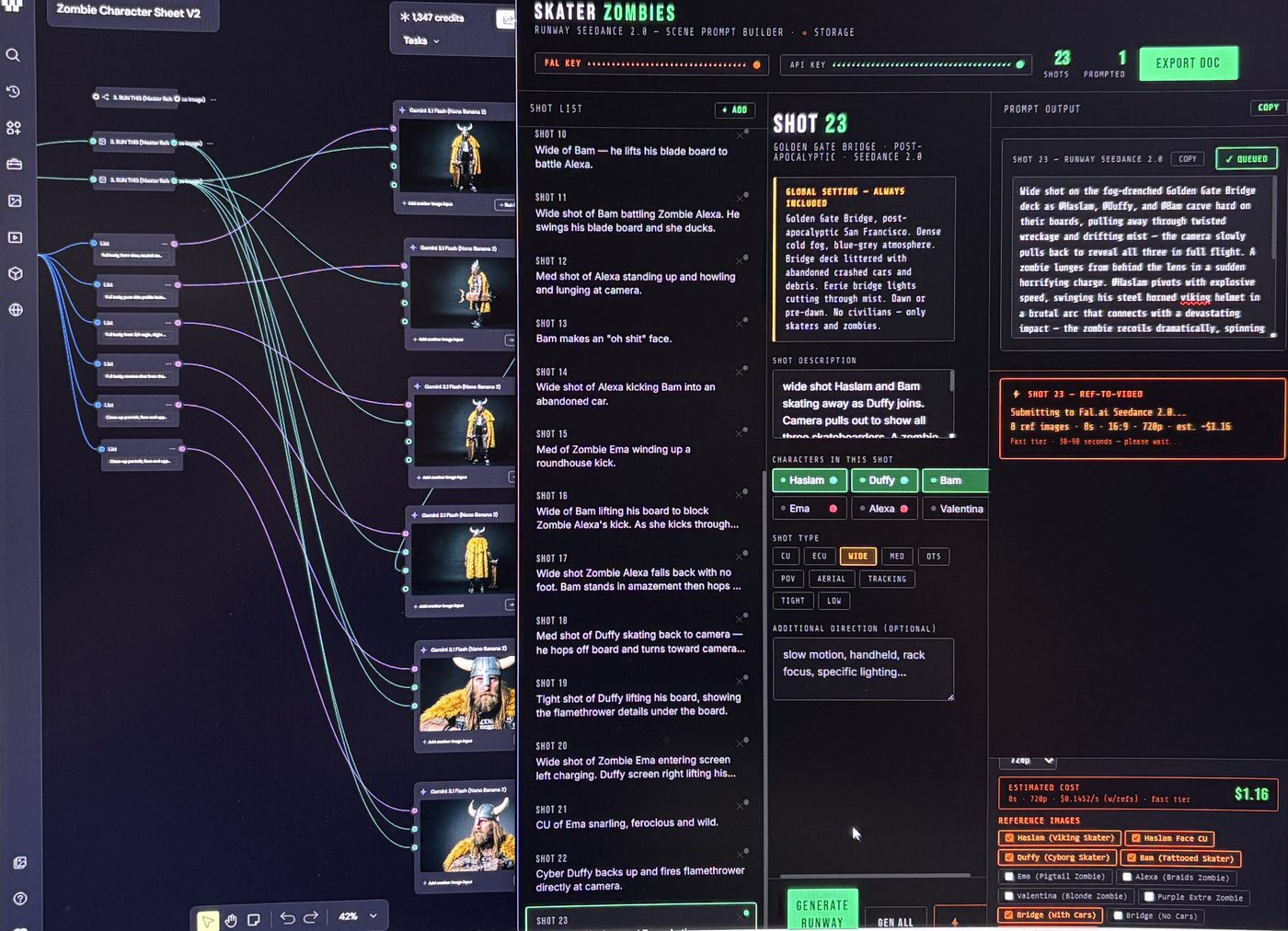
For this project — a feature teaser starring real professional skateboarders and MMA fighters as zombie-fighting leads — I closed that gap entirely. Using AI, I set the scene, lit it, chose the lens, controlled the weather, and directed the real talent — without a soundstage, a crew, or a single frame shot on location.
The trailer isn't a pitch deck anymore. It's the movie, in miniature — and it's now being shopped to investors.
And the system built to make it — a custom pipeline for prompt generation, reference-image matching, and batch rendering — didn't disappear when the trailer wrapped. A 12-hour build now pays back on every future production, whether that's this film or the next one.
Mercedes-Benz — Benzel Bush
A drone unit is its own production within the production — a separate operator, separate equipment, separate scheduling, coordinated on top of everything else already happening on set. Even when the shot itself is simple, the coordination overhead isn't.
For this project, aerial coverage that would have meant booking a 2-day drone unit at $3,000/day was instead generated with AI in a single day, at roughly $800–1,000 — no second production unit to schedule around, no separate crew to coordinate on set, just detailed pre-production conversation to get quality source material.
PAL Football
Not every project calls for reinventing the pipeline — sometimes the win is running a full production end to end, and knowing exactly where a shortcut belongs.
For this volunteer project, I ran the complete season's coverage: game-day shooting across multiple games, full post-production, and a graphics package — the kind of start-to-finish production management that a league with no production budget still needs someone to own.
The football was real, the kids were full of energy and often gloriously silly, and no AI tool was going to improve on either — the job was just to capture it well.
Where AI tightened the pipeline
Adobe Creative Cloud's Firefly-powered workflows were layered into post, trimming roughly 10 hours of manual labor out of the editing and graphics process across the season — freeing up more time to spend on the parts that actually mattered: the kids, the plays, the moments.
Not every project needs to be rebuilt around AI. Sometimes the win is knowing exactly where a shortcut fits into a pipeline that's already working — and where it should just get out of the way.